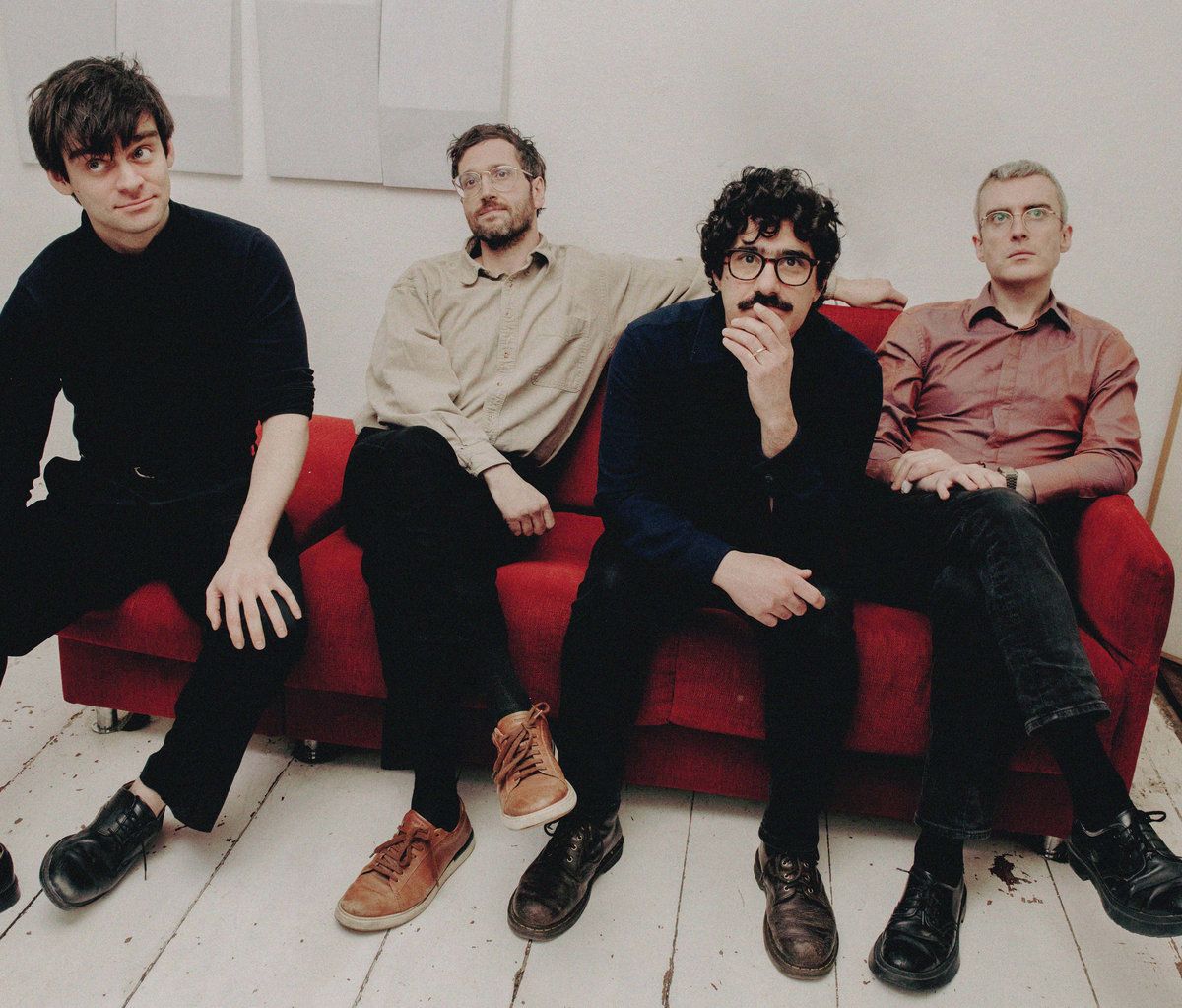
Horse Lords have released Demand to Be Taken to Heaven Alive!, their new album for RVNG Intl. The band's official Bandcamp page lists the release date as June 12, 2026, while Apple Music confirms the same date, a 12-song sequence, and a 40-minute runtime. For a group this committed to rhythmic architecture, that compact shape matters: the album looks dense on paper before a note even hits.
The core lineup is Max Eilbacher on bass guitar and computer, Andrew Bernstein on saxophone, percussion, and computer, Sam Haberman on drums, and Owen Gardner on guitar and percussion. Bandcamp also credits Nina Guo and Evelyn Saylor with vocals, Madison Greenstone with bass clarinet, and Weston Olencki with trombone, which points to a record that widens the band's grid without sanding down its obsessive internal logic.
Bandcamp Daily made the album its June 12 Album of the Day and framed the record around utopian architecture, remote collaboration, and the band's ability to make academic materials feel physical. The official credits back up part of that remote frame: Adam Asnan recorded in Berlin, Jared Paolini recorded in Baltimore, Gardner mixed the album, and Heba Kadry mastered it with assistance from Jacob Clements in Brooklyn.
Horse Lords can get filed under math rock, post-rock, avant-rock, or experimental rock depending on which door you enter through. Demand to Be Taken to Heaven Alive! seems built to make those doors swing into the same room. Pitchfork's New Music Friday roundup places it alongside the band's 2022 LP Comradely Objects and describes the new record as continuing a push between contemporary classical structure and improv-rock motion.
That is the right tension for this band. Horse Lords are at their best when the music feels engineered and unstable at the same time, as if the pattern might keep unfolding past the edge of the song. Demand to Be Taken to Heaven Alive! has the title of a manifesto and the credits of a small construction crew. The appeal is the friction between precision and lift, between scored complexity and the body-level pull of a band still chasing groove. For this corner of experimental guitar music, that is a pretty strong opening argument.