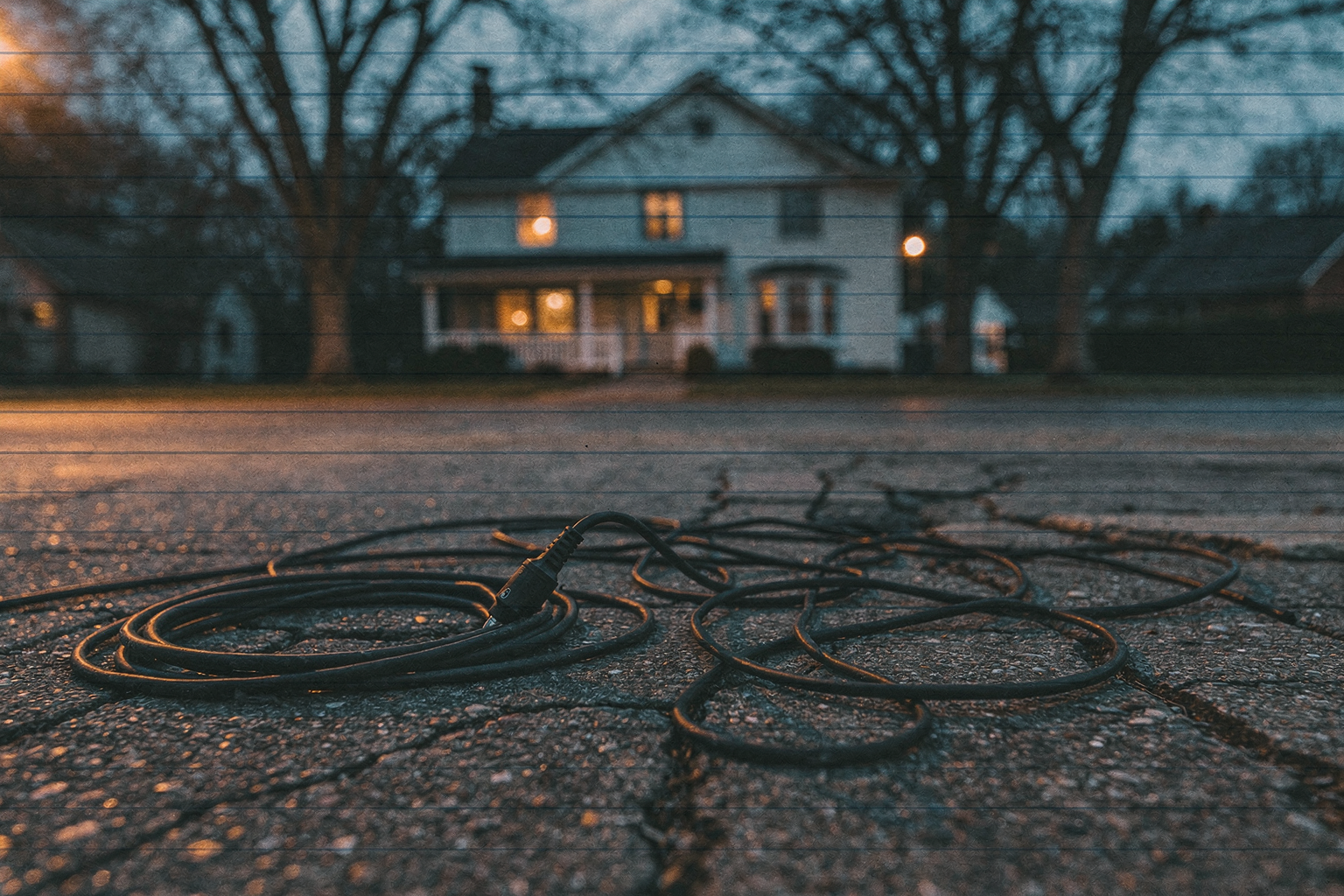
American Football is the easiest place to begin with Midwest emo because the record gives you a physical doorway. The house is right there. The guitars are bright enough to draw a map. The vocals sound like someone trying to tell the truth without waking anyone up. Polyvinyl's page for the self-titled 1999 album confirms the basics that made the myth portable: a September 14, 1999 release date, Polyvinyl Records, Mike Kinsella on vocals and guitar, Steve Holmes, Steve Lamos, Champaign, and Brendan Gamble at Private Studios. The label's 25th anniversary page adds the part that still matters most: Steve Holmes, Steve Lamos, and Kinsella were college kids who cut the LP in four days as spring slid into summer, with the band likely ending as soon as the album was done.
That is the frame, but it can become a trap. If American Football is treated as the entire genre, Midwest emo gets reduced to glassy arpeggios, a lamp in a second-floor window, and captions about failing to text back. The better way to hear LP1 is as a pressure point. It makes tenderness technical. It lets math-rock precision serve emotional hesitation. It turns empty space into arrangement. It is quiet, yes, but it is not passive. The songs keep circling the thing they cannot say, which is why they still feel active when the tempo barely moves.
The first turn after American Football should be Cap'n Jazz, because Cap'n Jazz blows up the idea that Midwest emo was born polite. Jade Tree's page for Analphabetapolothology says the collection compiles 34 songs spanning the band's history, with six previously unreleased tracks, and describes the band as leaving a long impression on the region's bohemian punk scene while spawning future scene stars including the Promise Ring and Joan of Arc. That is not a footnote. That is the wiring diagram. Cap'n Jazz is the messy room behind the clean house: yelped, unstable, funny, wounded, and more punk than the genre's later sweaters would suggest.
Start with "Little League" and "Oh Messy Life" if you need the quick proof. Those songs do not ask whether emotion can be dignified. They throw the dignity out first. The guitars sprint and trip. The vocals sound like a body trying to keep up with its own nervous system. If American Football taught listeners that emo could be architectural, Cap'n Jazz kept the scaffolding shaking. Their importance is not that every later band copied them directly. Their importance is that they made imbalance feel like a valid form.
Then go to Braid's Frame & Canvas. Polyvinyl lists the album as released April 7, 1998, on Polyvinyl Records, recorded by J. Robbins at Inner Ear Studios in December 1997. The same page calls it the definitive Braid album and links the leaner, more focused sound to the band's constant touring. That last detail explains why Frame & Canvas still hits differently from a lot of canon records. It sounds road-tested. It has the emotional voltage of emo, but it also has the reflexes of a band that has learned how to make weird rhythms work in real rooms.
Braid is where the genre's nervous motion turns into muscle memory. "The New Nathan Detroits" and "A Dozen Roses" are not just songs with tricky parts. They understand release. They understand how a chorus can arrive without sanding down the angles around it. Frame & Canvas is also a corrective to the idea that Midwest emo is mainly about fragility. This music can be fragile, but it is not weak. Braid's best songs feel like a person pacing a kitchen because standing still would be worse.
The real starter path, then, is not a ranking. It is a triangle. American Football gives you space. Cap'n Jazz gives you rupture. Braid gives you velocity. Once those three corners click, the rest of the map becomes easier to read. The Promise Ring's pop instincts make more sense. Joan of Arc's art-school deconstruction feels less random. Later revival bands stop sounding like nostalgic cosplay and start sounding like people arguing with different parts of the same inheritance.
That matters because Midwest emo is not a single sound. It is a set of tensions: precision versus collapse, sentiment versus embarrassment, guitar sparkle versus punk abrasion, suburban detail versus big feeling. The style's most durable records do not solve those tensions. They keep them audible. That is why LP1 can be both gentle and influential, why Analphabetapolothology can feel chaotic and foundational, why Frame & Canvas can sound technical without turning into homework.
A good listening order should respect that movement. Begin with American Football's "Never Meant," because refusing the obvious starting point is just contrarian theater. Then play "Honestly?" and "Stay Home" to hear how the record stretches absence until it becomes structure. Move to Cap'n Jazz's "Little League" and "Oh Messy Life" for the open-wire version of the feeling. Then put on Braid's "The New Nathan Detroits," "A Dozen Roses," and "I Keep a Diary" to hear the style become aerodynamic.
After that, follow your instinct. If you want melody, go toward the Promise Ring. If you want abstraction, go toward Joan of Arc. If you want the 2010s revival, listen for how younger bands borrowed the guitar language but changed the emotional temperature. Some made it cleaner. Some made it heavier. Some made it more online. The through line is not a chord shape. It is the sense that a song can sound like it is figuring itself out in real time.
The revival records are where the genre's internet-era reputation gets both clarified and warped. By the time younger listeners found LP1 through file-sharing, Tumblr, YouTube recommendations, vinyl reissues, and streaming-era canon lists, Midwest emo had already become less a regional scene than a portable emotional grammar. That portability is powerful, but it can flatten the history. A band in 2014 borrowing the twinkle does not automatically inherit the same context as a band in Champaign in 1998. The task for a listener is to hear both things at once: the continuity of the guitar language and the change in what that language is being asked to carry.
That is why Frame & Canvas belongs near the front of the guide instead of buried in the advanced syllabus. Braid keeps the style from becoming only pretty. Polyvinyl's source page emphasizes constant touring, and you can hear that in the songs. They are not bedroom sketches that accidentally learned to run. They are arrangements with road legs. The meter shifts and stacked vocals have a social quality, like four people arguing toward a chorus. That energy keeps Midwest emo connected to punk scenes, basements, college towns, and DIY rooms rather than letting it drift entirely into wistful wallpaper.
Cap'n Jazz does similar work from the other direction. Jade Tree's description of the band spawning future scene stars including the Promise Ring and Joan of Arc is a reminder that influence is not always tidy. One branch turns toward hooks. Another turns toward fragmentation. Another turns toward the inward geometry of American Football. If you only listen for the prettiest descendant, you miss the point of the family tree. Midwest emo is compelling because its DNA is unstable. It can produce a shout-along song, a mathy instrumental passage, a whispered confession, and a half-broken art-rock experiment without leaving the conversation.
For newcomers, the temptation is to ask which record is the best. A more useful question is which problem you want the genre to solve tonight. Need the record that turns distance into architecture? American Football. Need the record that makes awkwardness feel like gasoline? Cap'n Jazz. Need the record that proves technical playing can still sweat? Braid. Need melody with fewer sharp edges? The Promise Ring is waiting. Need the feeling of the form mutating in public? Follow Joan of Arc. None of those routes cancel the others.
The genre's modern abundance makes curation more important, not less. There are thousands of songs with clean guitars and aching vocals now, and plenty of them are fine. The classics still matter because they teach you what to demand from the newer wave. Do the guitars reveal character, or only signal taste? Does the vocal sound vulnerable because the song earned it, or because the mix buried it? Does the odd rhythm change the emotional stakes, or is it there to prove the band can count? Midwest emo survives when those choices feel necessary.
That is the part people miss when they turn Midwest emo into a mood board. The genre is not just a sad, pretty thing. It is a method for making uncertainty audible. American Football remains the cleanest entry because the record leaves so much air around that uncertainty. Cap'n Jazz remains essential because it refuses to clean the mess. Braid remains essential because it proves the mess can move. Start there, and the house on the cover stops being a destination. It becomes what it always was: one lit room in a much louder neighborhood.